




















Pain Relief Review – IGN
Blog Andrew Joseph 31 Oct , 2025 0
[ad_1]

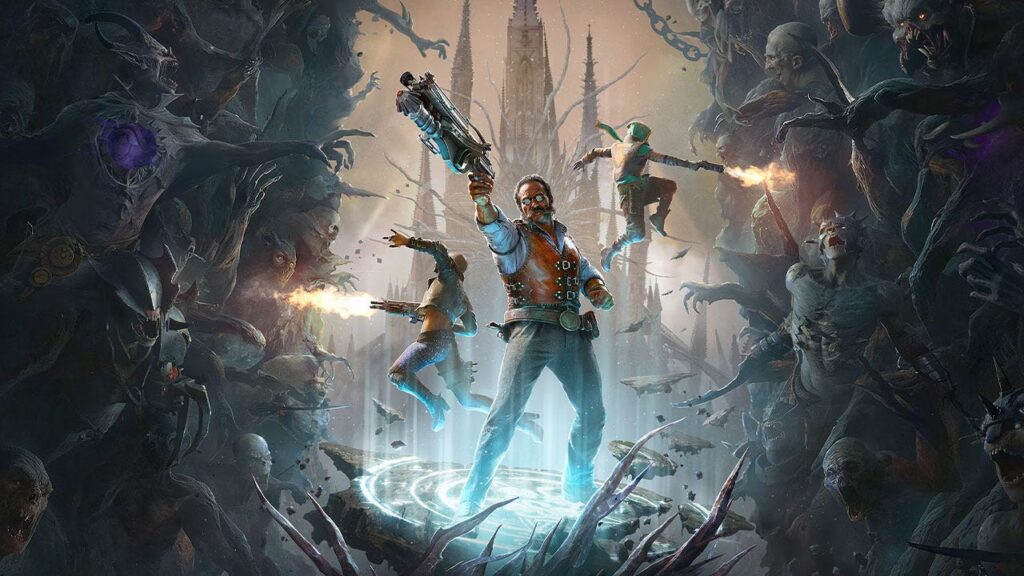
Every now and then, someone at a publisher will look at a beloved franchise they own, realize they could make it a live service co-op game, and say out loud, “I know this has never worked for other people, but it might work for us“. Of course, it never did. This outraged the original fanbase, and often the series is old enough that newer players don't even know what it is. The result is a game that's not for anyone, good-for-nothing driven by market forces, and a false belief that somehow, somehow, this time around the idea is just better Better than all previous attempts. This time, they were chosen by God to be immune to anything that would dismay lesser mortals. The latest game in this doomed genre is Painkiller, a reboot of People Can Fly's 2004 classic, and the results are as good as ever. It's fitting that it takes place in Purgatory. When it's consigned to the grave of history, its tombstone will read “Here lies 'Painkiller,' which is neither good enough for heaven nor good enough for hell. You'll wish you'd just played the original and called it a day, or simply played the Judas Priest song.”
This new painkiller is one of Those ones Cooperative games. You know the ones; a short tutorial precedes the meager plot, showing you the ropes and unlocking the basics of your operations. Once established, you pick from one of four visually distinct but nearly identical characters save for one passive ability, all of which come with prepackaged quips, most of which sound like they were written by dollar-store Joss Whedon. After choosing your weapons and gear, you can choose one of several missions, where you go to a location and kill a lot of bad guys, then return to your base with the loot, where you can upgrade your stuff and do it all over again. You've seen it all before, and I'm tired of describing it.
The story here is basically non-existent. You are one of four souls trapped in Purgatory – Ink, Void, Roch and Sol – approached by the disembodied voice of the angel Metatron to stop the demon Azazel, another faceless voice from Do Bad Things. Go on a mission, go home, spend the loot, repeat. To Painkiller's infinite credit, there's no paid currency or battle pass here, just a season pass with skins and such, but the cycle never changes – once you get new and better stuff, it's time to do whatever Metratron thinks needs to be done next.
If you've played the original, you're probably saying, “This really doesn't sound like Painkiller” – and you, the reader, win a solid gold Kewpie doll because it doesn't sound like Painkiller at all! If you squint, you can see the inspiration, although I use that word loosely. There are tarot cards, but you can “win” one of them by spending gold coins in the tarot lottery, since everything in video games is gambling these days (even if you're not spending real money), and equip them before missions to get bonuses like +50 health and 30% more damage. Once the mission is over, your tarot cards will be used up and you must spend more gold coins in the lottery or ancient souls gained in the mission to restore the one you used before. You can also use these currencies to buy and upgrade weapons, but you usually don't have enough currency to do this and have tarot cards early on.
Speaking of which, much of the original game's iconic arsenal is resurrected here, like the Stakegun and Electrodriver, along with their fun alternative firepower. However, the titular painkiller (the one you've always had) is now doing its best impression of Doom Eternal's chainsaw, giving you more ammo when your other guns run out. Sometimes a level locks you into a large, usually circular or rectangular space and lets you kill a lot of enemies, though none of them are as visually striking or crazy as the original Rogue's Gallery. The similarities end there. This isn't a painkiller game; This is a piece from Warhammer 40,000: Darktide wearing the Painkiller skin set, hope no one notices.
Painkiller looks great, but its problems really come down to mission design. Even though the environments look different, they feel similar, and each of the three scenarios (each divided into three levels) finds a single gameplay idea and never lets go of it. your progress will be blocked something The only way to do that is through the mechanics of “Doing That Act”: in the first, this means killing nearby enemies and placing them in place, thus filling the bucket with blood; in the second, you need to find and use soul vessels to power things; and in the third, you have to stand on a ritual marker to activate the dreamcatcher.
Sometimes Painkiller mixes it up – I actually enjoyed the point where my team had to use soul vessels to power a large vehicle we had to escort, but moments like these were rare. For the most part, you'll be doing the same thing over and over again, moving around the environment, collecting gold, finding hidden chests, and picking up consumables – one that lowers your health, another that lowers your health. Another plops down ammo; the third is a nearly useless decoy you'll never pick up unless the other two are unavailable; the fourth is an extra life; that's it. You're then locked into the combat arena until you acquire enough blood canisters/soul containers/dreamcatchers to move forward, or everything in your path dies.
Even the combat isn't as satisfying as it should be. Most enemies come in swarms, which are harmless on their own but can be dangerous in large numbers (and they always Appearing in large numbers) can easily die. There are also larger, more dangerous demons that you can stun or kill outright by lighting a replacement fire, as well as the Nephilim who act as bosses at the end of the Bakumatsu. With the exception of the Nephilim, none of these are all that appealing, and while there are a few different types of legions and a handful of demons, none of them have much of a unique visual identity. Without Psychoununs, Hell Bikers, Evil Samurai, or Freaks, there's nothing to make the original game's wacky evil ensemble memorable. No, this would be heavy metal album cover hell if it were generated by artificial intelligence. If you're going to take painkillers, at least look like Painkillers, you know?
Perhaps most infuriating of all, painkillers aren't exactly Bad. Movements are fast, precise, and really fast – you can glide, dash, air dash, sprint through the enemy, Bounce off walls to double jump and use painkillers to grab onto different anchors (or enemies!). All six guns, whether they're electric drives, rocket launchers, hand cannons, stakeguns, shotguns or submachine guns, all feel great, and I enjoyed playing around with the various alternative firepowers. A shotgun that freezes enemies so I can crush them? Neat. A stake gun that's also a grenade launcher or can create gravity wells? Love it. Turn a rocket launcher into a minigun that shoots freezing rockets? Sign Me Up New upgrades on branching paths for weapons feel meaningful and change the way you play. Yes, a lot of it is “We have Doom Eternal at home,” but if you're going to steal, you might as well steal the best.
I even started to like the characters, especially Thor, a brash, forever-young priestess, and Void, a straight man with a self-proclaimed fishbowl for his head and no memory of his past. Even Ink's sarcasm and self-loathing and Roch's tragic backstory are well-written, really. (The bad stuff is reserved for combat dialogue.) The problem is that you rarely get to hear them finish telling each other their stories, because you'll encounter some enemy, background heavy metal (which is nice) will intervene, or another character will spout some boring combat dialogue, and the story dialogue you hear stops and never resumes. Yes, you can read it in the codex at your base, but it's not voiced, and the voice actors did an admirable job with what they had. Too bad.
The boss battle with the Nephilim is also quite exciting. They're not groundbreaking – you've seen a lot of these mechanics before – but they're engaging and look cool, whether they're giant blood rats, large statues hiding secrets, or actual dragons. These are the best parts of the four or so hours it takes to play Painkiller's raid (read: campaign) mode directly, and a nice change of pace from “we're not locked in here with you, you're locked in here”. us” Standard encounter.
Painkiller is designed as a three-player co-op game, which is the best way to play it, but if you're short on friends or have no one around online, the bots are great and respond well to player commands. Commanding them to stand on a switch to open a secret area isn't as intuitive as having your partner see the switch and do it directly, but it does work, and I didn't mind playing with the bots without anyone else.
Still, disappointment spread. I thought Painkiller's blink-and-you'll-miss-it plot was intended to set us up for a showdown with Azazel after completing all nine levels, but that's not the case. You simply enter His empty tomb, where His voice offers you the opportunity to work for Him. Your character naturally declines, and he turns to offering, I kid you not, an actual line of dialogue, “higher difficulty,” and the opportunity for more violence and mayhem. Sure, Azazel, why not? I already have so Very interesting.
There's also a roguelike mode to try, which I really like because unlike the Raid levels, it has more variety and you can take the rewards back with you. You might navigate platforming sections between battles that deal damage to you as long as you're in them, or have to carry a soul jar to the top of a ziggurat. Even the “we're going to lock you in a combat arena until everything else is dead or all of you are dead” scenarios are more interesting here because you've never seen these environments before, and the randomness of your weapons, alternative fire, and tarot cards feel more natural. It's like a painkiller reboot should be Before someone decides that a campaign should be launched too. Unfortunately, the first time I played a roguelike, my game crashed. Talk about cursed things.
[ad_2]
Source link